
SEMTO ST-FL2 FAQ: How It Works, Setup, Carburetor Tuning and Troubleshooting
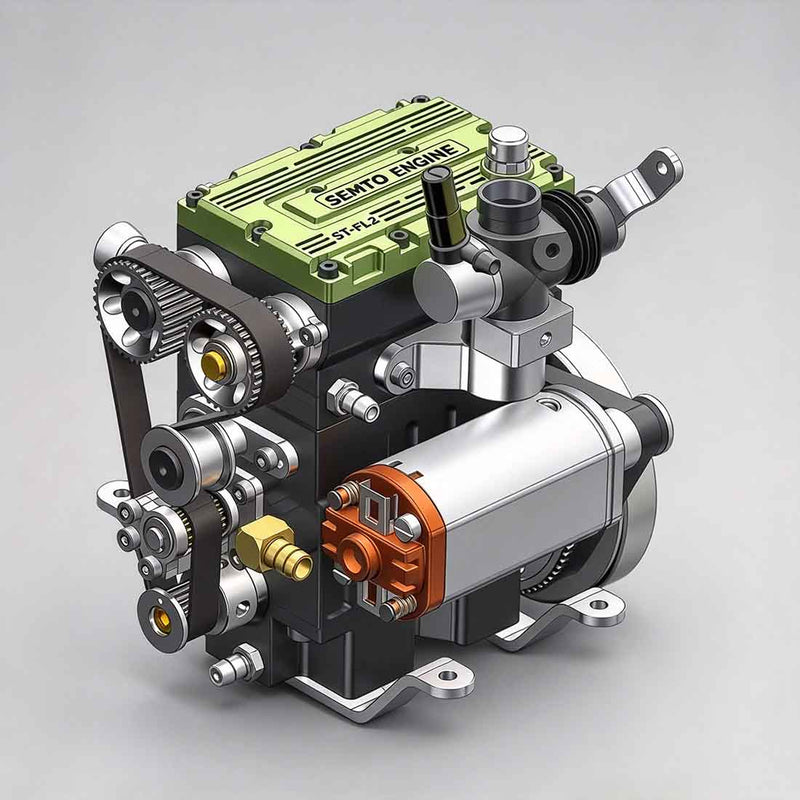
Thank you for choosing Stirlingkit and the SEMTO ST-FL2.
The SEMTO ST-FL2 is an 8.6cc water-cooled inline twin four-stroke nitro engine that you build yourself. It has a single overhead camshaft, one carburetor, push-button electric start and a built-in water pump, and it was developed with 1/8-scale RC projects in mind. As the next generation of the NR200, it adds higher compression, improved connecting rods and a built-in belt tensioner.
This guide brings together the questions we hear most from builders, from how the engine works and how to connect the starter kit, to tuning, troubleshooting and storage. Use the links below to jump to the section you need.
Before You Buy
Is the SEMTO ST-FL2 a real running engine?
Yes. The SEMTO ST-FL2 is a working 8.6cc inline twin four-stroke nitro engine, not an electric display model. Once assembled and fitted with the Starter Kit, it runs on nitro fuel.
Is the SEMTO ST-FL2 good for beginners?
Yes. The SEMTO ST-FL2 has one carburetor to tune, push-button electric start and a full assembly video to follow. It is still a real fuel-powered engine, so take your time with the manual during assembly and the first runs.
Does the SEMTO ST-FL2 come assembled?
No. The SEMTO ST-FL2 is a KIT version that you build yourself. A printed manual, a basic installation tool and a full assembly video are provided to guide you through every step.
Will the SEMTO ST-FL2 run straight out of the box?
No. After assembly, you also need the ST-FL2 Starter Kit, an 11.1V 3S LiPo battery with a T-plug and 25% nitro fuel.
What's included with the SEMTO ST-FL2?
The SEMTO ST-FL2 KIT includes the engine kit, a basic installation tool and the instruction manual. The running parts come in the ST-FL2 Starter Kit, sold separately.
What's included in the SEMTO ST-FL2 Starter Kit?
- 3-in-1 starter, ignition and power module (push-button start, T-plug)
- 2 × F-type glow plugs
- Fuel tank and pink fuel line
- Water-cooling radiator with mounting brackets
- Water tank and clear water line
The battery and fuel are not included.
Is there a gasoline version of the SEMTO ST-FL2?
No. The SEMTO ST-FL2 is a nitro engine. If you prefer gasoline, the SEMTO ST-NF2 is available in a gasoline version.
What's the difference between the SEMTO ST-FL2 and the NR200?
The SEMTO ST-FL2 is the next generation of the NR200. It keeps the same 8.6cc water-cooled inline twin layout, but has higher compression, about 30% more power, a higher normal RPM range, redesigned connecting rods, a starter motor that can go on either side and a built-in belt tensioner. It also comes as a kit rather than fully assembled. Read the full comparison: NR200 vs SEMTO ST-FL2.
Do NR200 parts fit the SEMTO ST-FL2?
No. The SEMTO ST-FL2 and NR200 use different parts, so starter kits, spare parts and accessories are not interchangeable.
What's the difference between the SEMTO ST-FL2 and the SEMTO ST-NF2?
The SEMTO ST-NF2 is a 7cc air-cooled twin, available in nitro or gasoline, and costs less. The SEMTO ST-FL2 is an 8.6cc water-cooled twin with about twice the power and a higher RPM range. Parts are not interchangeable. Read the full comparison: SEMTO ST-NF2 vs ST-FL2.
How the SEMTO ST-FL2 Works
Simplified diagram. See the instruction manual for exact connection points.
The SEMTO ST-FL2 runs on three simple systems working together. Here is what each line in the diagram does:
Electrical system (black)
The 11.1V 3S LiPo battery plugs into the 3-in-1 module with a T-plug. When you press the start button, the module does three jobs at once: it heats both glow plugs so they can ignite the fuel, it powers the 480 starter motor to spin the engine, and it supplies power to the system. The ground wire connects the module to the engine's metal casing to complete the circuit. Once the engine fires, release the button.
Fuel system (pink)
The fuel tank holds 25% nitro fuel. The pink fuel line carries it to the carburetor, which mixes the fuel with air in the right ratio and feeds both cylinders. The main needle and idle screw on the carburetor set how rich or lean that mixture is.
Cooling system (blue)
While the engine runs, its built-in water pump pushes coolant around the cylinders to carry heat away. The warm water travels through the clear water line to the radiator, where it cools down. The water tank keeps the system topped up and relieves pressure, and the cooled water flows back into the engine. This loop runs continuously as long as the engine is running.
Put together: the electrical system starts the engine, the fuel system keeps it running, and the cooling system keeps its temperature steady.
See the connections in action
The full assembly video shows how to build the SEMTO ST-FL2 and connect the 3-in-1 module, glow plugs, fuel line and water lines, step by step.
How does the SEMTO ST-FL2 engine work?
The SEMTO ST-FL2 is a four-stroke engine, just like a full-size car engine. Each of its two cylinders repeats the same four steps:
- Intake: the piston moves down and the intake valve opens, drawing in the fuel-air mixture from the carburetor.
- Compression: both valves close and the piston moves up, squeezing the mixture.
- Power: the glow plug ignites the mixture, and the combustion pushes the piston down, turning the crankshaft.
- Exhaust: the exhaust valve opens and the piston pushes the burned gases out through the exhaust pipe.
The two cylinders fire at different times, so the crankshaft gets power more often and the engine runs more smoothly.
How are the valves on the SEMTO ST-FL2 opened and closed?
The SEMTO ST-FL2 uses a single overhead camshaft (SOHC). A timing belt connects the crankshaft to the camshaft, which turns at half the crankshaft speed. As the camshaft turns, its lobes press on the rocker arms, which open each valve at exactly the right moment. This is why correct belt tension matters: if the belt slips, the valve timing is lost.
How does the glow plug ignite the fuel in the SEMTO ST-FL2?
A glow plug has a small metal coil inside. When you start the SEMTO ST-FL2, the 3-in-1 module heats the coil until it glows. The heat, together with the methanol in the fuel, ignites the compressed mixture. Once the engine is running, the heat of each combustion helps keep the coil hot.
How does the water-cooling system on the SEMTO ST-FL2 work?
A centrifugal water pump, driven by the engine, pushes coolant through passages around the cylinders, where it picks up heat. The warm water flows through the clear water lines to the radiator, where it cools down, while the water tank keeps the system topped up and relieves pressure. The cooled water then returns to the engine, and the cycle repeats as long as the engine runs.
How does the electric start on the SEMTO ST-FL2 work?
When you press the start button on the 3-in-1 module, the 480 brushed starter motor turns the flywheel through a belt, spinning the engine fast enough for it to fire. At the same time, the module powers the glow plugs. Once the engine starts, release the button.
Why does the SEMTO ST-FL2 use nitro fuel?
Nitro fuel is a blend of methanol, nitromethane and oil. Methanol is the main fuel and works with the glow plug to ignite. Nitromethane makes ignition easier and adds power. The oil lubricates the engine as it runs, which is why the SEMTO ST-FL2 has no separate oil sump.
Specifications
What are the main specifications of the SEMTO ST-FL2?
- Engine type: inline twin, four-stroke, SOHC nitro engine
- Displacement: 8.6cc (2 × 4.3cc)
- Bore × stroke: 18.0 × 17.0 mm
- Power: 1.2 HP
- Speed: 3,000–20,000 rpm, up to 22,000 rpm
- Cooling: water-cooled with a built-in centrifugal water pump
- Starting: electric start (480 brushed motor)
- Size and weight: approx. 113 × 92 × 103 mm, approx. 900 g
What battery does the SEMTO ST-FL2 need?
An 11.1V 3S LiPo battery with a T-plug, connected to the 3-in-1 module in the Starter Kit.
What fuel does the SEMTO ST-FL2 use?
25% nitro fuel. The SEMTO ST-FL2 uses mixed lubrication, so the oil in the nitro fuel lubricates the engine. Do not use gasoline.
What glow plugs does the SEMTO ST-FL2 use?
Two F-type glow plugs, one per cylinder. Both are included in the ST-FL2 Starter Kit. A glow plug is a wear part, so keeping a spare on hand is a good idea.
Which belts does the SEMTO ST-FL2 use?
The SEMTO ST-FL2 uses MXL belts: 107-7 MXL and 92-6 MXL. These are different from ST-NF2 and NR200 belts.
Does the SEMTO ST-FL2 need oil in the crankcase?
No. The SEMTO ST-FL2 uses mixed lubrication, so there is no oil sump to fill. The oil already in the nitro fuel lubricates the engine as it runs. Always use nitro fuel that contains oil, and use after-run oil for storage.
Can I run the SEMTO ST-FL2 at 22,000 rpm all the time?
No. The SEMTO ST-FL2 is designed to run between 3,000 and 20,000 rpm in normal use. It can reach up to 22,000 rpm, but running at maximum RPM for long periods increases wear, so keep top-speed runs short.
Can I use a different glow plug in the SEMTO ST-FL2?
We recommend the F-type glow plugs supplied in the ST-FL2 Starter Kit. Not every glow plug suits this engine: a plug with a longer thread or element can reach too far into the cylinder and touch the piston. If you want to use a different plug, please check with us first.
Setup and First Start
How do I connect the fuel and water lines on the SEMTO ST-FL2?
In the ST-FL2 Starter Kit, the pink tube is the fuel line (fuel tank to carburetor) and the clear tube is the water line (water pump, radiator and water tank). Keeping them apart during setup avoids most first-start problems.
Does the SEMTO ST-FL2 radiator need a fan?
No. The radiator in the ST-FL2 Starter Kit is a passive water-cooling radiator, so no cooling fan is needed.
How do I wire the SEMTO ST-FL2 3-in-1 module?
- Connect the two ignition lead caps to the glow plugs.
- Connect the positive and negative wires to the starter motor terminals.
- Connect the ground wire to the engine's metal casing.
- Connect the T-plug to an 11.1V 3S LiPo battery.
How do I fit the glow plug caps on the SEMTO ST-FL2 without breaking the wires?
Before use, squeeze the crimp section of each copper cap firmly with pliers so it holds the wire securely. When fitting or removing a cap, always hold the copper cap itself, not the wire, and push it straight onto the glow plug.
Can the SEMTO ST-FL2 starter motor be mounted on either side?
Yes. The SEMTO ST-FL2 starter motor can be mounted on the left or the right, so you can choose the side that fits your setup or RC chassis best.
Does the SEMTO ST-FL2 need a break-in period?
For the first few tanks of fuel, keep the main needle slightly on the rich side and avoid running at full speed for long periods. This helps the new engine settle in. Once it runs smoothly, you can fine-tune for best performance.
Is there a diagram showing how the SEMTO ST-FL2 Starter Kit parts connect?
Yes. The instruction manual shows how the engine, 3-in-1 module, battery, fuel system and cooling system connect. In short: the pink fuel line runs from the fuel tank to the carburetor, the clear water line connects the water pump, radiator and water tank, and the 3-in-1 module connects to the glow plugs, starter motor, engine casing and battery. If anything is unclear, send us a photo of your setup and we will help.
Can I run the SEMTO ST-FL2 without the water-cooling system connected?
No. Always connect and fill the radiator, water tank and water lines before starting the SEMTO ST-FL2. Running a water-cooled engine without coolant, even briefly, can cause it to overheat and damage the engine.
Carburetor Tuning
How do I tune the carburetor on the SEMTO ST-FL2?
The SEMTO ST-FL2 has a single carburetor with two adjustments: the main needle (the knurled needle on top) for full throttle, and the idle mixture screw for low speed. Clockwise makes the mixture leaner, counterclockwise makes it richer. Let the engine warm up first and adjust about 1/8 turn at a time.
- Start from the factory setting. The main needle is set about [X] turns open from fully closed. If you are not sure where it is, gently close it, then open it [X] turns.
- Set the main needle. At full throttle, slowly lean the needle until the engine reaches its highest RPM, then turn it back 1/8 to 1/4 turn richer. Slightly rich is cooler and safer.
- Set the idle. At idle, briefly pinch the fuel line. If the RPM rises for a few seconds before the engine stops, the idle is too rich, so lean it slightly. If it stops almost immediately, it is too lean, so richen it slightly.
How can I tell if my SEMTO ST-FL2 is running too rich or too lean?
- Too rich: heavy smoke, a sluggish response and difficulty reaching high RPM. Lean the main needle slightly.
- Too lean: very little smoke, the engine gets very hot, and RPM drops or the engine stops at full throttle. Richen the main needle right away, as running lean for long periods can damage the engine.
My SEMTO ST-FL2 stalls when I open the throttle quickly. What should I do?
This usually means the idle mixture needs a small adjustment. Use the fuel line pinch test to check whether it is too rich or too lean, then adjust the idle mixture screw 1/8 turn at a time until the engine picks up smoothly.
Troubleshooting
My SEMTO ST-FL2 won't start. What should I check?
- Battery: make sure the 11.1V 3S LiPo is fully charged and the T-plug is connected.
- Glow plugs: check that both glow plug caps are secure and the plugs glow. A burned-out plug is the most common cause of a no-start.
- Fuel: check that fuel reaches the carburetor through the pink fuel line and that there are no air bubbles or leaks.
- Flooding: if the engine turns but won't fire, it may have too much fuel. Remove the glow plugs, spin the engine with the starter to clear the cylinders, refit the plugs and try again.
- Carburetor setting: if the needle has been moved, return it to the factory setting.
The SEMTO ST-FL2 starter spins but doesn't turn the engine. What's wrong?
First check that the starter belt is fitted correctly and has the right tension. If the starter only engages some of the time, or the engine does not turn at all, a part in the starter drive may be worn. Please send us a short video at service@stirlingkit.com so we can help identify the cause.
The SEMTO ST-FL2 feels stiff or won't turn over by hand. What should I do?
Do not force it or try to start it with the starter. A stiff engine, especially after storage, is often caused by a sticking valve or old fuel residue. Remove the glow plugs, add a few drops of after-run oil to each cylinder and gently turn the engine by hand. If it still binds, contact us with a description or video before running it.
My SEMTO ST-FL2 overheats. What should I check?
- Check that the cooling system is full and there are no air bubbles in the water lines.
- Make sure the water pump belt is turning and the water lines are not kinked.
- Check that the main needle is not set too lean. A lean mixture makes the engine run hot, so richen it slightly.
Maintenance and Storage
The timing belt on my SEMTO ST-FL2 feels loose. What should I do?
The SEMTO ST-FL2 has a built-in belt tensioner. Loosen the tensioner screw, move the tensioner pulley until the belt is snug with only a little play when pressed lightly, then tighten the screw again. A loose belt can slip at high RPM, so check the tension from time to time.
How do I service the connecting rods on the SEMTO ST-FL2?
The SEMTO ST-FL2 has easy-to-remove connecting rods, so you can inspect or replace one without taking the whole engine apart. The connecting rods also have a lubrication hook and two oil holes each, which help reduce wear when the engine is run regularly with the correct fuel.
How should I store the SEMTO ST-FL2 after running it?
Nitro fuel contains methanol, which absorbs moisture and can cause corrosion if left inside the engine. After your last run:
- Run the fuel tank dry, or drain it, and let the engine run until it stops.
- While the engine is still warm, remove both glow plugs and add a few drops of after-run oil to each cylinder.
- Turn the engine over by hand several full turns to spread the oil.
- Drain the water from the cooling system, especially before cold weather.
- Refit the glow plugs and store the engine somewhere dry.
What should I check before running the SEMTO ST-FL2 after long storage?
Turn the engine slowly by hand for several full revolutions. It should turn smoothly, with compression felt on each cylinder. If you feel a tight spot or the engine binds, check the valves before starting, as a valve can stick after long storage. Refill the cooling system and check the water lines for leaks before running.
RC Projects
Can I put the SEMTO ST-FL2 in an RC car?
Yes. The SEMTO ST-FL2 was developed with 1/8-scale RC cars in mind and leaves room for a clutch and transmission. The starter motor can be mounted on the left or right to suit your chassis. Fitment always depends on your chassis, drivetrain, mounting and cooling setup.
Is there a clutch for the SEMTO ST-FL2?
A dedicated SEMTO ST-FL2 clutch is in development. Select "Notify Me" on the product page to hear when it is available.
Design Questions from Our Readers
Why does the SEMTO ST-FL2 use a timing belt instead of a chain or gears?
A timing belt is lighter and quieter than a chain or gear train, needs no lubrication of its own and is easy to inspect and replace at home. Many full-size car engines use a timing belt for the same reasons. To keep the belt running reliably at high RPM, the SEMTO ST-FL2 adds a built-in belt tensioner, so you can take up any slack yourself.
Will the timing belt on the SEMTO ST-FL2 slip at high RPM?
Belt slip is almost always caused by a belt that has loosened. The SEMTO ST-FL2 has a built-in belt tensioner, so if the belt feels loose, simply adjust the tensioner until the belt is snug. Checking the tension before each running session keeps the timing accurate at high RPM.
Have the connecting rods been improved on the SEMTO ST-FL2?
Yes. Connecting rod reliability was one of the main pieces of feedback from earlier twin-cylinder engines. The SEMTO ST-FL2 connecting rods have a lubrication hook and two oil holes each, so oil reaches both ends of the rod during high-RPM running. They are also easy to remove, so you can inspect or replace a rod without taking the whole engine apart.
Does the SEMTO ST-FL2 have more power than the NR200?
Yes. Thanks to higher compression, the SEMTO ST-FL2 produces about 30% more power than the NR200 and is rated for a higher normal RPM range of 3,000–20,000 rpm.
Can I use the SEMTO ST-FL2 in my own 1/8-scale car design?
Yes. Many builders design their own chassis around the SEMTO ST-FL2. It measures approx. 113 × 92 × 103 mm and weighs approx. 900 g, and the starter motor can be mounted on the left or right. For cooling, plan space for the radiator and water tank from the Starter Kit, and route the water lines away from the exhaust.
Help and Support
Where can I find the SEMTO ST-FL2 manual?
A printed manual comes in the box. You can also find it on our Download Manual page.
Is there an assembly video for the SEMTO ST-FL2?
Yes. You can watch the full SEMTO ST-FL2 assembly video before or during your build.
Can I buy spare parts for the SEMTO ST-FL2?
Yes. Please contact us at service@stirlingkit.com with the part you need, and if possible, a photo. Please choose parts made for the SEMTO ST-FL2, as ST-NF2 and NR200 parts do not fit.
Have a question that isn't answered here? Email us at service@stirlingkit.com, and we will be happy to help.


0 kommentarer