


Building a Miniature V8? The Essential Torque & Tuning Guide for CISON V8 & TOYAN V8 Engines
How calibrated torque control, thin-wall spark sockets, and zero-guesswork tools turned a nerve-wracking scale V8 engine build into pure mechanical bliss.
There is nothing quite like having a precision miniature V8 sitting on your workbench. Under the bright bench lamp, hundreds of mirror-finished CNC billet parts gleam: 8 tiny aluminum pistons, a counterbalanced cross-plane crankshaft, gleaming bronze rod bushings, and 16 miniature pushrod valves.
It is the absolute holy grail of scale mechanical modeling. But if you’re anything like me, that initial rush of adrenaline is immediately followed by a cold wave of sweat: “This is a four-figure precision masterpiece. If I strip a single aluminum thread or crush a rod bearing, there is no quick trip to the auto parts store to fix it.”
Unlike real-life Chevy small-blocks made of heavy cast iron, engines like the CISON LS-52, CISON 44cc, and TOYAN FS-V800WGPC Gasoline V8 feature micro steel fasteners (M1.6, M2, M2.5) threading straight into soft 6061-T6 aluminum. Using clumsy hardware store allen keys is like performing open-heart surgery with a pipe wrench.
Here are the 4 game-changing moments where having a dedicated model engine toolkit completely transformed my V8 build—and why it’s the best $139 insurance policy you will ever put on your workbench.
The Dream Engines on Our Benches
Whether you're piecing together an unbuilt kit or fine-tuning an assembled runner, these beauties deserve pro-grade tooling:


The 16 Rod Bolts: That Incredible Clutch Cutoff ASMR
Every V8 builder knows that installing the 8 connecting rods onto the tiny crankshaft journals is pure white-knuckle territory. There are 16 micro M1.6/M2.0 bolts. Hand-tighten them with an allen key, and you’re flying blind: Did I crush the brass shell? Did I leave it too loose?
With the electric torque driver dialed to Setting 1 (0.6 N·m), it completely changes the game. You slide the hardened S2 hex bit into the bolt, press the trigger, and whirrrrr-CLICK! The internal mechanical clutch disengages with this supremely crisp, tactile snap the exact microsecond it reaches target torque.
You tighten the mate, reach over to the flywheel, and spin the crank with your thumb. Zero binding. It glides silky-smooth like it's floating on a layer of oil. That feeling of pure mechanical harmony is worth the price of admission alone.
No More Cracked Porcelain: The Ultra-Thin Spark Plug Sockets
We’ve all been there: your engine has a mysterious misfire on cylinder 5, so you go to pull the ME8 miniature spark plug. You grab a standard 1/4” socket from your garage toolbox and try to drop it down between the billet valve cover and the cooling fins.
It doesn’t fit. The socket wall is 1.8mm thick, so it wedges tightly against the aluminum well. You try to wiggle it loose, the socket tilts sideways, and—snap!—you hear the heartbreaking crunch of the tiny ceramic insulator fracturing. Now you're waiting a week for a replacement plug.
The Ultimate Model Engine Tool Box includes custom-machined 6mm and 8mm deep thin-wall sockets with razor-slim 0.7mm sidewalls. They slide down the spark plug well like silk, seat squarely over the hex, and pull the plug out effortlessly with zero rubbing on the cylinder head. It feels like a tool purpose-built by someone who actually runs these engines.
Adjusting 16 Valves Without Losing Your Mind (The Two-Handed Lock)
Setting valve lash on an OHV V8 used to be my personal nightmare. You slide a 0.05mm feeler gauge between the rocker and valve stem, dial in the adjustment stud with a tiny flathead, and reach for a wrench to tighten the jam nut. But the moment the nut bites, friction drags the center stud with it—and your carefully tuned 0.05mm gap instantly balloons to 0.15mm.
Here is the pro setup: you pop the SL1.5 flat bit onto the driver, leave it in manual lock mode, and hold the center stud dead still. Then, with your other hand, you slip the ultra-slim 4.5mm open-ended wrench (which actually fits into the tight rocker spring gap!) around the jam nut and cinch it tight. Zero stud creep. The feeler gauge pulls through with perfect buttery drag every single time.
Anodized Aluminum Case: Your Bench Looks Like an F1 Pit Garage
Before this kit, my workbench was a disaster zone: magnetic trays with scrambled bits, bent allen keys mixed with screwdrivers, and half the time spent on my hands and knees looking for a dropped H1.5 bit that rolled off the table.
Opening this solid CNC aluminum case and seeing every single bit labeled in custom-cut, high-density foam changes your whole headspace. Every H1.5, H2.0, H2.5, Torx bit, spark socket, and slim wrench has its designated home. When you sit down with your engine on a Friday evening, it doesn't feel like wrestling with random hardware—it feels like an elite Formula 1 engine assembly station.
⚡ V8 Builder’s Quick Torque Cheat Sheet
- Connecting Rod Cap Bolts (M1.6/M2.0): Setting 1 (0.6 – 0.8 N·m) — Always spin crank after each rod!
- Cylinder Head Bolts (M2.5/M3.0): 3-Stage X-pattern (0.8 N·m → 1.5 N·m → 2.2 N·m final lock).
- Crankcase & Oil Pan Split Bolts: Setting 2 (1.2 – 1.5 N·m) — Work from center outward.
- ME8 Miniature Spark Plugs: Snug down gently, then add 1/4 turn using the thin-wall socket (~1.5 N·m).
- Rocker Arm Jam Nut: Firm hand lock with the 4.5mm slim wrench while holding the center stud.
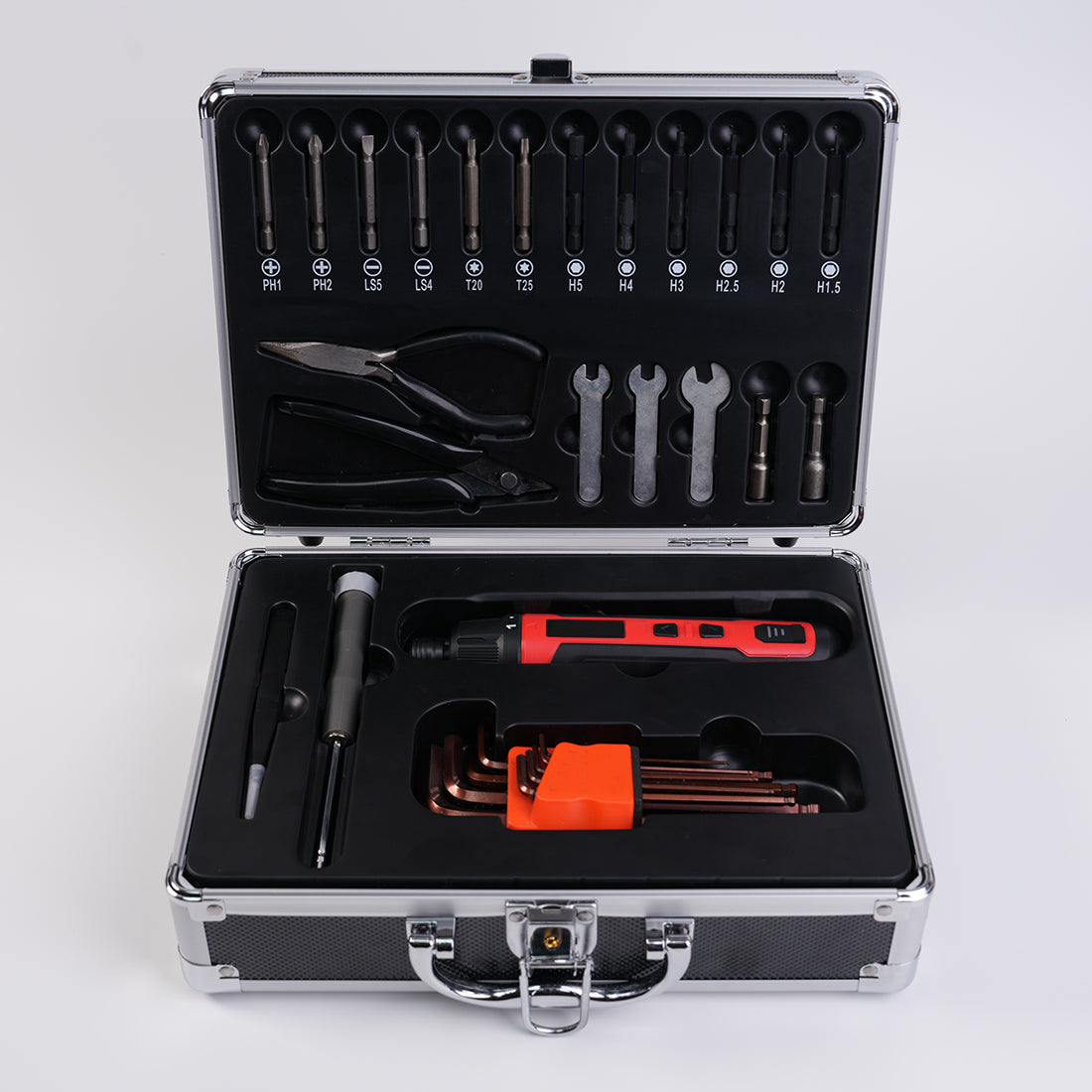
Build with Confidence. Protect Your Engine Investment.
Stop risking stripped billet aluminum or bent connecting rods with hardware-store tools. Get the 0–6 N·m torque electric driver, thin-wall spark plug sockets, ultra-slim rocker wrenches, and labeled S2-alloy bits in a heavy-duty workshop case.
Get the Ultimate Model Engine Tool Box ($139.99) →


0 commenti